


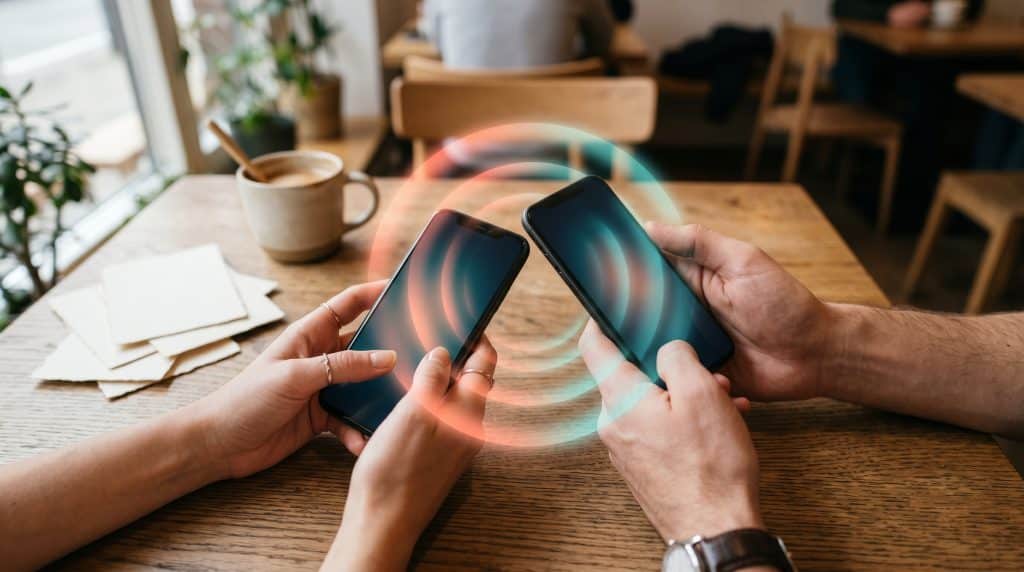
I have a drawer. You probably have one too. It is full of business cards from people I genuinely meant to follow up with, and could not tell you a single thing about today. The card outlived the connection by about eighteen months, which is exactly backwards.
That drawer is why I think so much about networking without business cards — not as a sustainability talking point, but as a practical problem of how two people actually stay connected after they shake hands. I’ve spent the last few years building a proximity social app, which means I meet people in rooms, at booths, and in coffee-shop queues constantly. This is the field guide I wish someone had handed me: what’s broken, what the “digital card” crowd gets wrong, and a simple framework for the exchange itself.
Why the paper business card already lost
Let’s be honest about the artifact we’re replacing. The most-cited number in this space comes from an Adobe study: roughly 88% of business cards are thrown out within a week of being handed over. Globally we still print on the order of 100 billion of them a year. That’s not a networking tool, that’s confetti with a phone number on it.
The deeper issue isn’t waste — it’s asymmetry. A paper card is a one-way broadcast. I hand you a static rectangle, you stuff it in a pocket, and the relationship now depends entirely on you manually typing my details into your phone later, which you won’t. The card carries one version of me, frozen at print time, with no way for you to tell whether I’m reachable, active, or even still at that company.
So the card has two fatal flaws: it’s one-directional, and it’s a dead snapshot. Hold those two flaws in mind, because the “modern” replacement quietly inherits both.
The trap of the one-way digital card
Walk any conference floor in 2026 and you’ll see the upgrade: tap a phone against an NFC card, or scan a QR code, and a sleek profile page loads. The market has noticed — analysts put the digital business card industry around $217 million in 2026 and climbing at roughly a 12% annual clip, with about 37% of businesses now using some form of digital card. The tech is real and the convenience is genuine. NFC retains contacts meaningfully better than QR alone, and hybrid tap-or-scan cards are the fastest-growing format precisely because they cover both phone types.
But here’s the founder’s-eye observation, and it’s the whole point of this guide: most digital cards solved the paper problem, not the networking problem. Tapping your NFC card at me is still a one-way handoff. Your profile loads on my screen. Mine does not load on yours. We’ve made the broadcast faster and prettier, but it’s still a broadcast. The vendor sells you a card so that you can push your details outward — the incentive is one-directional by design.
Real networking is never one person beaming a profile at another. It’s an exchange. And an exchange that only goes one way isn’t an exchange at all; it’s a leaflet.
The two questions a good exchange has to answer
When I’m deciding whether a tool actually replaces the business card, I ask two things:
- Is it mutual? After we part, do we both have a live way to reach the other — or did only one person come away with a contact?
- Is it alive? Does what I shared keep working after the moment — updating when I change roles, showing where I’m actually active — or is it another frozen snapshot in a different format?
Paper fails both. The one-way digital card passes “alive” but still fails “mutual.” That gap is the opportunity.
A field guide to networking without business cards
Here’s the framework I actually use in the wild. It works whether or not you ever install anything I’ve built.
1. Lead with the platform you both already live on
The single most useful upgrade is to stop thinking “contact details” and start thinking “where are you actually reachable?” For a designer that might be Instagram; for a developer, GitHub or LinkedIn; for a musician, Spotify. The mistake the paper card made was forcing everyone onto the same generic fields — name, title, phone, email — when the real connection lives on a platform.
So my first move on meeting someone is rarely “here’s my email.” It’s “what’s the best place to find you?” Match the platform to the person and the follow-up actually happens.
2. Make the exchange mutual in one motion
Whatever tool you use, insist that both people walk away with something live. If you tap your NFC card at me, follow it immediately by pulling up my profile too. If you’re using an app that shows nearby profiles, the exchange is mutual by default — we both surface for each other in the same instant, no card-as-leaflet involved. The test is simple: thirty seconds after we part, can each of us reach the other without retyping anything? If not, you handed out a leaflet.
3. Share a profile, not a data point
A phone number tells you nothing. A profile that links someone’s Instagram, LinkedIn, TikTok, YouTube, and Spotify in one place tells you who they are, what they make, and where the conversation can continue. This is the core of why I built around linking many platforms rather than one tidy field: a single card line is a fact; a multi-platform profile is a person. When you can see the seven places someone shows up online, you don’t need to remember which one they mentioned — you just pick the one that fits.
This plays out for me constantly. Someone I’ve just met will ask for my WhatsApp, and instead of dictating a number I’ll say, “You can just grab it from BeApp — I’m right next to you.” There’s always a half-second of surprise, then a grin: “Oh — yes, of course.” That tiny moment is the whole thesis of going card-free. The information was already shareable the instant we were in the same room; the number, the spelling-it-out, was never the connection — it was just friction in front of it. Remove the friction and the exchange feels less like admin and more like, well, meeting someone.
4. Use proximity instead of a stack of cards
The most underrated fact about in-person networking is that the people you most want to reach are, by definition, near you right now. The old card workflow ignored this completely — you collected a stack and sorted it out at home, by which point the room was a blur. Reversing it (closest people first, while you’re still standing in the room) is a small change that fixes the “who was that, again?” problem at the root, because you connect in the moment instead of reconstructing it from a stack of rectangles later.
5. Decide what you’re sharing before you tap
A card you hand over reveals everything printed on it; you can’t selectively share. Modern tools let you split a personal presence from a business one and choose which face to show. I keep them genuinely separate — the people I meet at a founder dinner see a different version of me than someone I meet at a gig. Decide which “you” is meeting this person before the exchange, not after.
Why this matters more than it sounds
It’s tempting to file all this under etiquette. It isn’t. The landmark causal study of professional networks — a five-year experiment across more than 20 million LinkedIn users, published in Science in 2022 — found that it’s our weak ties, the loose acquaintances rather than our close circle, that most drive new job opportunities. The slightly-awkward person you met once at an event is statistically among the most valuable connections you’ll ever make.
Which is exactly the connection the paper card kills, and the one-way digital card only half-saves. Weak ties are fragile by definition. They survive only if both people come away with a living, mutual line back to each other. Get the exchange right and you’re not just saving a tree — you’re protecting the connections most likely to change your career.
The thirty-second test
Forget the format wars between paper, NFC, and QR for a second. The only question that matters is the one I started with: thirty seconds after you part ways, can you both reach each other, on a platform you both actually use, with a profile that’s still alive next year? If yes, you’ve networked. If only one of you can — or if it’s a snapshot that’ll be stale by autumn — you’ve just made more confetti.
That standard is what I built BeApp around: meeting the people near you, surfacing for each other mutually, and carrying every platform you’re on in one verified profile instead of one frozen line. If your networking drawer looks anything like mine did, it’s worth a try.