
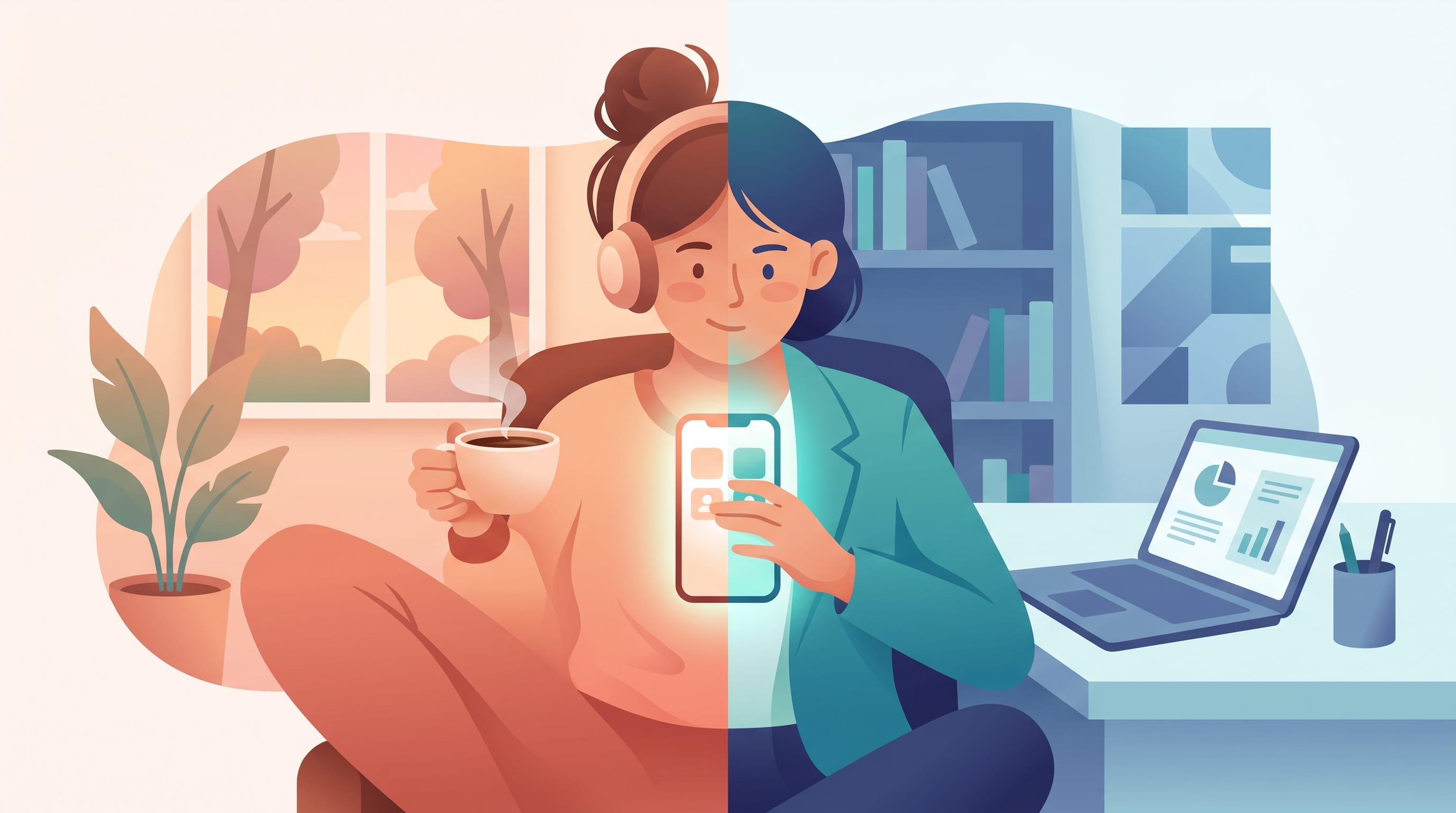
Somewhere between posting a gym selfie and pitching a client, most of us hit the same wall: the version of you your friends know isn’t the version your customers should see. The internet’s standard fix is blunt — “just make a second account.” But if you’ve ever tried to separate personal and business social media that way, you already know the hidden tax: two logins, two content calendars, two notification streams, and a phone that buzzes twice as often. There’s a smarter way to keep one life from bleeding into the other, and it doesn’t require a burner phone or a duplicate of every app you own.
I’m Marten, and I built BeApp partly because I lived this problem. This is the framework I wish someone had handed me years ago — useful whether or not you ever install a thing.
Why you instinctively want to separate personal and business social media
The discomfort has a name. Researchers Alice Marwick and danah boyd called it context collapse: the flattening of many different audiences — friends, family, coworkers, customers, strangers — into a single space where one message meant for one group leaks to all the others (Marwick & boyd, 2011). In real life you naturally code-switch. You talk to your mother differently than you talk to a recruiter. Online, a single feed strips that nuance away, and your self-presentation gets unstable (overview here).
That instability isn’t just awkward — it’s exhausting. When every post has to satisfy your boss, your audience, and your group chat simultaneously, posting becomes a negotiation. And the people doing the most posting are paying for it. In a 2025 study of 1,000 creators, 52% reported experiencing burnout, with 37% saying they’d considered leaving the profession entirely (Billion Dollar Boy, 2025). A separate study of 542 North American creators by Creators 4 Mental Health put burnout even higher, at 62% (Tubefilter, 2025). Managing audiences you can’t actually keep apart is a real driver of that fatigue.
The “two accounts” trap nobody warns you about
The default advice — open a second account — solves the visibility problem and creates four new ones.
1. Maintenance doubles, attention halves
The average social media user is already active on close to seven platforms a month (Smart Insights, 2025). Duplicate every one of those into a “personal” and “business” version and you’ve turned seven obligations into fourteen. Each needs a bio, a profile photo, a posting cadence. Most people quietly abandon half of them within a month.
2. The accounts drift apart
Update your headshot, your job title, your new handle — now do it again on the other account. In practice, the second profile goes stale, so the version of you a new contact finds is often the wrong one.
3. You still leak
Duplicate accounts don’t stop context collapse; they just relocate it. Tag the wrong profile, comment from the wrong login, or get followed by a coworker on the “personal” one, and the wall you built is suddenly transparent.
4. It’s a part-time job you didn’t apply for
Two of everything means two inboxes to triage and two notification firehoses competing for the same finite attention. That’s not separation — it’s just more work wearing a costume.
A better model: one identity, two faces
Here’s the reframe that changed how I think about this. You don’t actually want two identities. You want one identity that can present a different face depending on the room you’re in. That’s exactly how you behave offline, and it’s the principle behind how I’d tell anyone to separate personal and business social media today.
Instead of cloning your accounts, you curate two views of a single, well-maintained presence and switch between them deliberately. One profile, two faces. The plumbing stays unified; only the public face changes based on context.
Step 1: Sort every link into Personal or Business
List every platform you’re on. Now ask one question per item: if a stranger met me in a professional setting, would I want them to see this? Your portfolio site, LinkedIn, a business email, your work-focused channel — those are your Business face. Your close-friends Instagram, your music taste, your gaming handle — Personal. Some links live in both. Most don’t.
Take a freelance photographer I’ll call Dana. Her Business face is her portfolio site, a polished Instagram of client work, a LinkedIn, and a booking email — four links that answer “can I hire you?” Her Personal face is a second, locked Instagram for friends, a Spotify she actually wants people to judge her by, and a Letterboxd account. The Instagram name overlaps, but the content goal is completely different, so it sits in both faces deliberately rather than by accident. The whole sort took her ten minutes and immediately exposed three dead links she’d been quietly embarrassed by for a year.
Step 2: Decide what each face is for
Business face = discoverability and credibility. It should answer “what do you do and how do I work with you?” in five seconds. Personal face = connection. It can be looser, weirder, more human. Mixing the two goals into one feed is what dilutes both.
Step 3: Make the switch a deliberate act, not an accident
The magic isn’t in having two faces — it’s in controlling when each one is visible. At a conference, you’re in Business mode. At a friend’s birthday, you’re in Personal mode. The switch should be intentional, like changing what you say when you walk into a different room.
One pattern is worth calling out, because it’s the most common way people quietly undercut themselves. The two modes are intuitive — most people grasp Business versus Personal right away. But some don’t want the effort of maintaining both, so they set up a single Personal mode and then fill it with their business handles. Now neither job is done well: friends land on a professional portfolio, and prospects get the personal feed. If you’re only going to run one mode, match the handles to what that mode is actually for. The split costs almost nothing to set up — and skipping it is the one shortcut that tends to backfire.
When NOT to separate
This framework isn’t a law. If your work is your personality — you’re a solo creator whose brand is literally “you,” or a coach whose warmth is the product — forcing a clean split can flatten the exact thing people came for. The same goes early on, before you have enough professional links to fill a Business face at all. In those cases, run one well-curated face and revisit the split when a real audience boundary appears. The point is to relieve friction, not to manufacture a wall you don’t need.
How this works in practice without a second phone
This is the part generic productivity blogs can’t really show you, because it needs a profile that’s built to hold two faces at once. In BeApp, your single profile has a Personal & Business mode built in. You connect your 10+ platforms — Instagram, TikTok, X, Snapchat, LinkedIn, YouTube, Spotify and more — once, in one verified place, then sort them into the face each belongs to.
When you’re at a venue or an event and BeApp shows you the profiles of people nearby, closest first, you choose which face they see. Flip to Business mode at a networking night and the person two tables over discovers your work side. Flip back to Personal at the bar afterward and that’s gone. One device, one login, one identity — two faces you control. No duplicate accounts drifting out of sync, and because you decide when you’re even visible at all, the leak risk of the “two accounts” approach simply isn’t there.
The mindset shift worth keeping
If you take nothing else from this: separation isn’t about hiding, and it isn’t about becoming two different people. It’s about respecting that different rooms call for different faces, and refusing to let a single feed force you to be one flattened version of yourself for everyone at once. That flattening is what context collapse does, and it’s a quiet contributor to the burnout the data keeps surfacing.
Audit your links this week. Decide what each face is for. Build the habit of switching on purpose. Do that, and you’ll spend less energy managing the gap between who you are with friends and who you are with clients — because you’ll have stopped trying to be both at the same time.
Your personal life and your business deserve their own spotlight. They just don’t need their own phone.