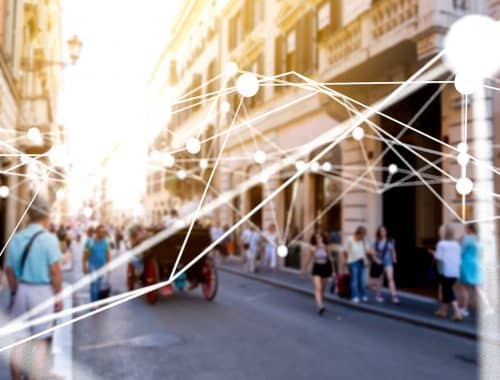
Open almost any social app and the first question its algorithm asks is the same: what will keep you scrolling? The post at the top of your feed isn’t there because it’s recent or relevant to your life. It’s there because a model predicted you’d engage with it. That single design choice, optimizing for predicted engagement, shapes nearly everything you see online. And it’s exactly the choice I decided not to make when I built BeApp’s Nearby feed.
This is a piece about ranking logic, specifically about proximity-based social networking and why I’m convinced that sorting people “closest first” is a fundamentally better answer than “most popular first” when the goal is to actually meet someone. You don’t need to download anything to get value from this. If you’ve ever wondered why your feeds feel loud but lonely, the ranking signal underneath is a big part of the story.
What “most popular first” actually optimizes for
Modern feeds are recommendation engines. When you open Instagram, the algorithm pulls roughly 500 recent candidate posts, filters out rule-breakers, then scores each one by how likely you are to engage, weighing your past interactions, the format, and the post’s overall engagement rate. TikTok’s For You Page works the same way: roughly 65% of views on the platform come from the For You Page rather than from accounts you follow, mostly surfaced from people you’ve never met. The mechanics differ platform to platform, but the objective function rarely does: maximize predicted engagement, then rank by that score.
Engagement-based ranking is genuinely good at one thing: retention. Research consistently shows engagement-optimized feeds keep people on-platform longer than chronological ones. That’s why nearly every major platform adopted it. But “what holds attention” and “who I could realistically meet” are not the same target, and optimizing hard for the first quietly sabotages the second.
There’s a well-documented cost, too. Recommendation systems that explicitly target engagement maximization have been shown to make networks more polarized by reinforcing existing clusters, and the broader filter-bubble literature links engagement optimization to narrowed exposure and amplified homogeneity. A popularity-ranked feed is, almost by definition, a rich-get-richer machine: the accounts with the most reach get the most reach. That’s fine for entertainment. It’s a terrible map of the room you’re standing in.
Why proximity-based social networking flips the signal
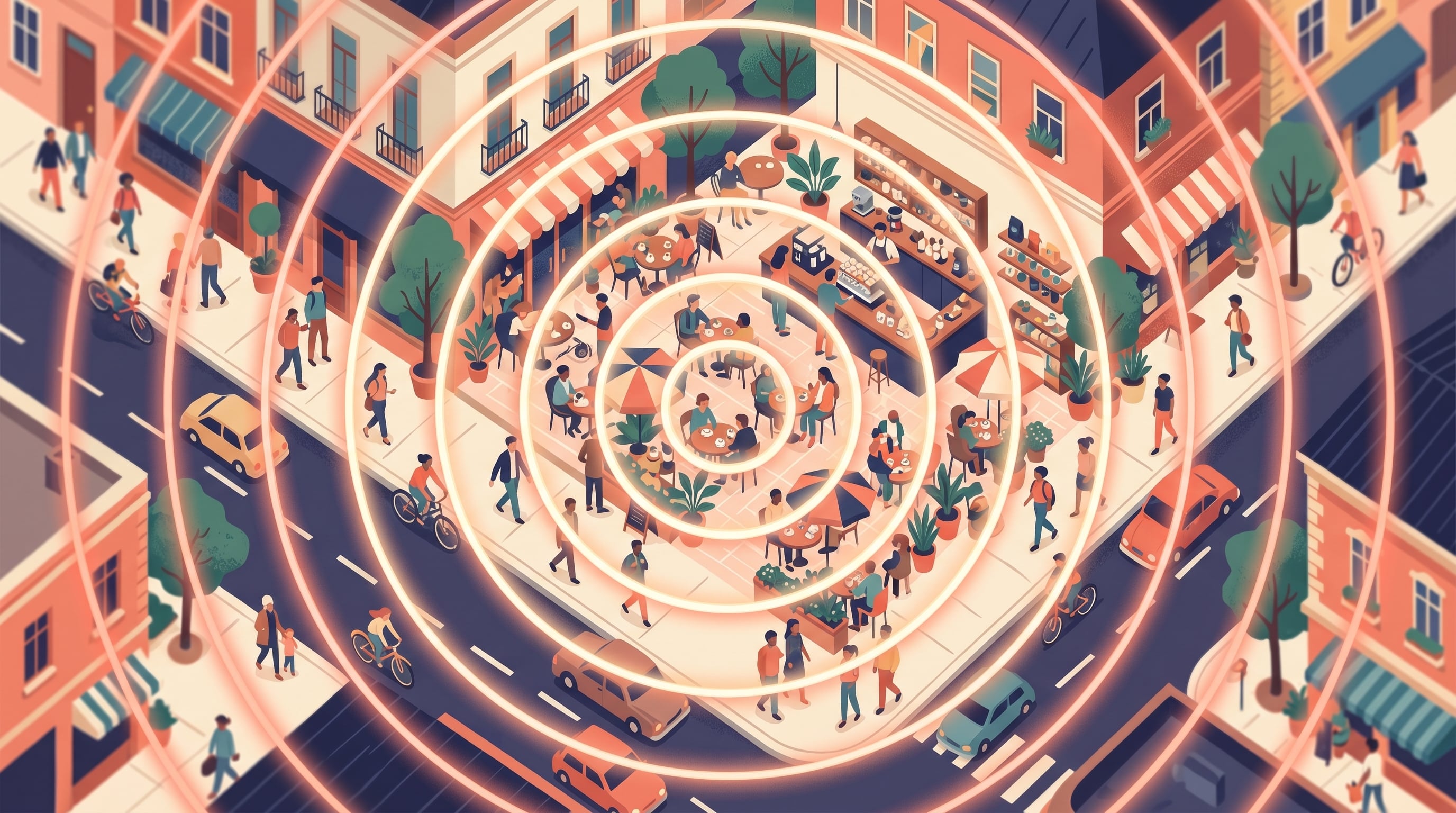
Here’s the core idea. In a popularity feed, the ranking signal is distance from average attention, how far above the engagement baseline a piece of content sits. In proximity-based social networking, the ranking signal is literal physical distance: how many meters away a person or place actually is, right now.
That swap matters because physical distance is one of the most honest relevance signals that exists. Geographers have a name for the intuition behind it. Tobler’s First Law of Geography, first presented in 1969 (published 1970), states that “everything is related to everything else, but near things are more related than distant things.” It’s the foundation of spatial analysis, and it captures something feeds forgot: closeness predicts relevance. The barista 15 feet away, the founder at the next table, the gallery across the street, these are more actionable to you than a viral account two countries over, no matter how many followers it has.
So in BeApp’s Discover Nearby feed, the closer someone is, the higher they appear. Not the most followed. Not the most “engaging.” The closest. That’s the whole inversion, and it changes the texture of who you discover.
Closest = most actionable
The design philosophy I keep coming back to is this: closest is most actionable. A ranking is only as useful as the action it makes possible. Popularity ranking is optimized for an action you take alone, on a screen, tapping and scrolling. Proximity ranking is optimized for an action you take with your body, standing up, walking ten steps, saying hello. When distance is the sort key, the top of your feed is, by construction, the most reachable thing in your world at that moment.
This also fixes the cold-start unfairness baked into popularity feeds. A new venue with zero followers is invisible in an engagement feed. But if that venue is the café you’re literally inside, proximity ranking puts it at the top, where it belongs. Reach stops being a prerequisite for being seen. Being here is enough.
Honestly, the idea didn’t come from a whiteboard — it came from sitting in a cafeteria. I’d look around and just be curious about the people near me: who they were, what they were into — and it had nothing to do with how many followers they had online. The person one table over was more interesting to me in that moment than any verified account in my feed, precisely because they were there. That’s the instinct “closest first” is built on. Popularity feeds answer “who is winning the internet.” Proximity answers a far more human question: “who is actually around me right now?” I wanted to build for the second one.
The trade-offs, honestly
Distance-as-relevance isn’t free of problems, and pretending otherwise would be dishonest. Three trade-offs are worth naming.
1. Density dependence
Proximity ranking is only as good as the people around you. In a packed neighborhood it’s electric; on an empty rural road it’s quiet. This is density dependence, and it’s the sharpest limit on the model. Popularity feeds don’t have this problem, they pull from the entire internet, so a feed is never empty even when your street is. Proximity discovery makes the opposite bet: that the highest-value connections are the ones close enough to act on. Picture a Tuesday-night supper club with forty people in one room. An engagement feed would rank that room by whoever has the biggest following; a proximity feed ranks it by who is actually within arm’s reach, so the quiet regular two seats down outranks a celebrity three cities away. The honest answer is that proximity discovery is built for the places where humans actually cluster: cafés, campuses, conferences, high streets, events. It’s a tool for the room you’re in, not a replacement for the whole web, and it rewards going where people gather.
2. Privacy is non-negotiable
Any system that ranks by location has to earn trust on privacy, full stop. Proximity-based apps have a real, documented history of surveillance and location-leak risks, and that’s not a footnote. My answer is structural: you’re visible only when you choose, you can go invisible at any moment, and location is used to rank in the moment, not stored or sold as a history of your movements. Distance can be a ranking signal without becoming a tracking log. If an app won’t let you disappear instantly, that’s a red flag regardless of the feature set.
3. It rewards presence, not performance
This one is a feature disguised as a trade-off. Popularity feeds reward the people best at producing content. Proximity feeds reward the people who simply show up. If you’ve built an audience, a distance-ranked feed won’t hand you a head start, and that’s the point. The currency shifts from clout to presence.
What this means for you, app or no app
Even if you never touch a proximity app, the ranking lens is worth carrying around. Every feed you scroll is answering a question, and it’s almost never “who could I actually meet?” Knowing the objective function behind a feed tells you what it’s for, and what it quietly costs you. An engagement feed is a great way to be entertained and a poor way to find the person sitting across the room.
If you do want to try the inversion in practice, BeApp’s Discover Nearby ranks the people and venues around you closest first, lets you connect 10+ platforms in one verified profile, switch between personal and business mode, and stay invisible until you choose otherwise. It’s the smallest possible change to how a feed is sorted, and in my experience it changes who you end up meeting.
Popularity ranking asks who the world is watching. Proximity ranking asks who’s within reach. For meeting actual people, the second question is the one worth answering.